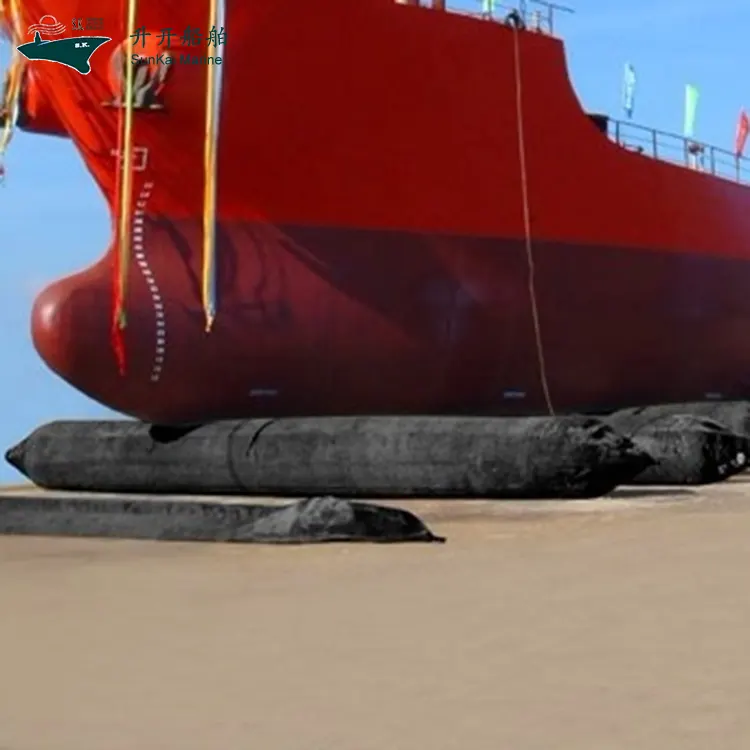
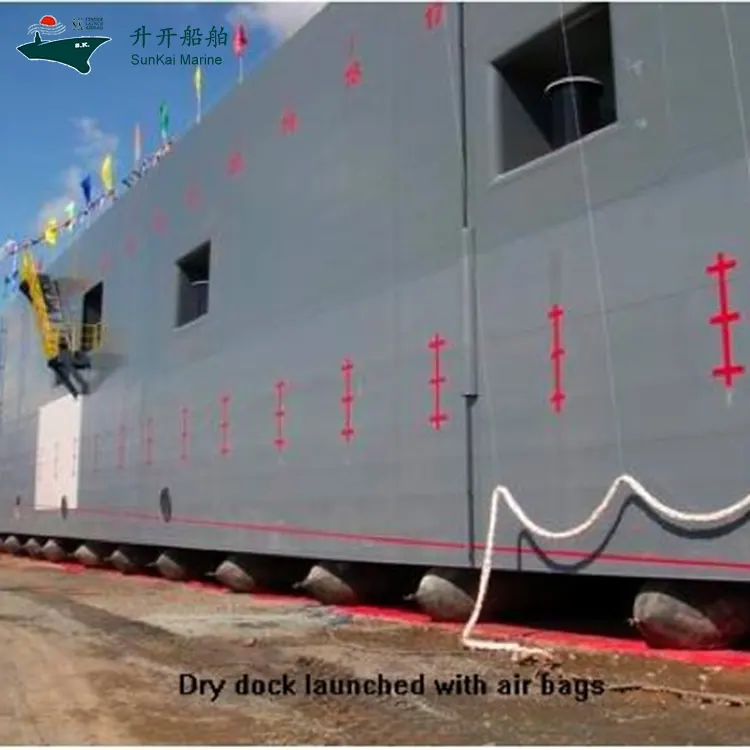
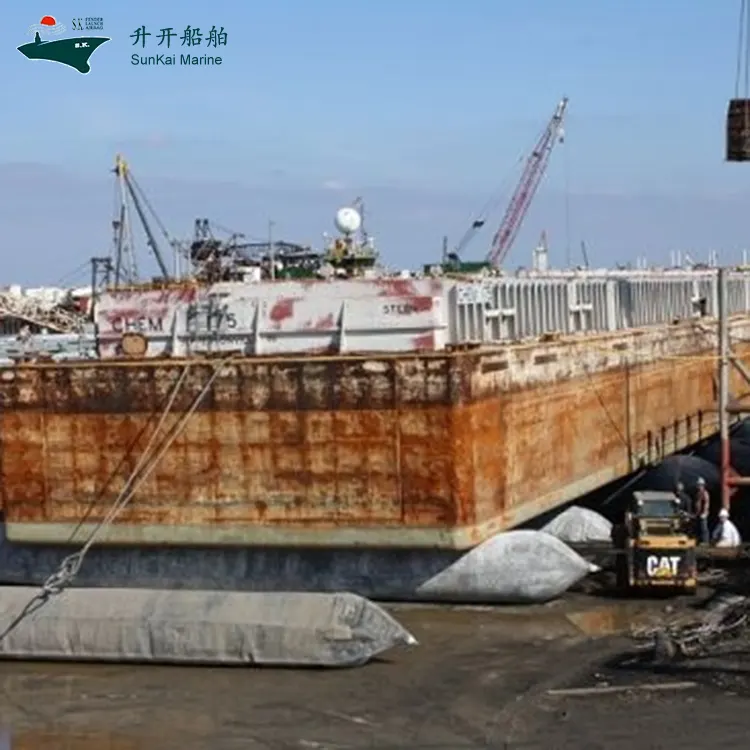
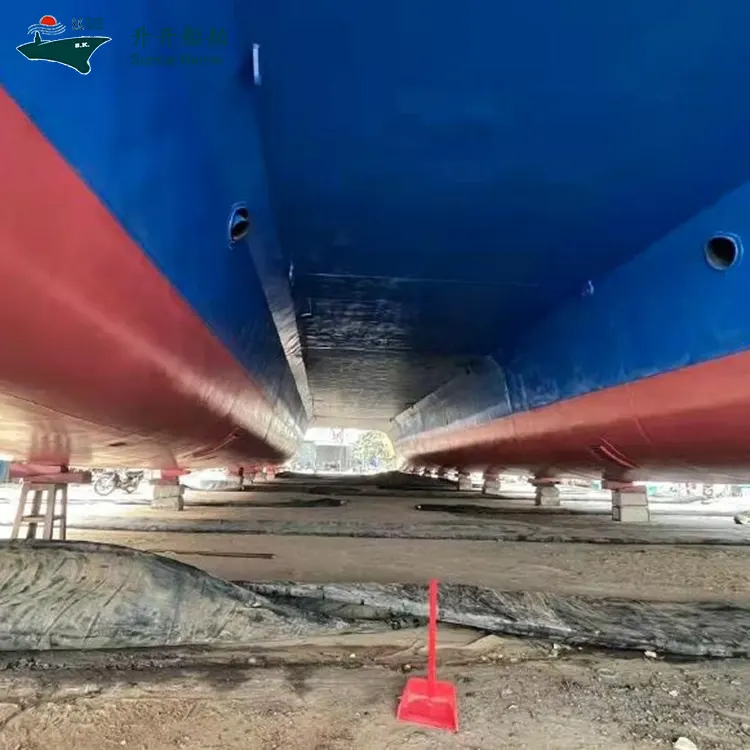
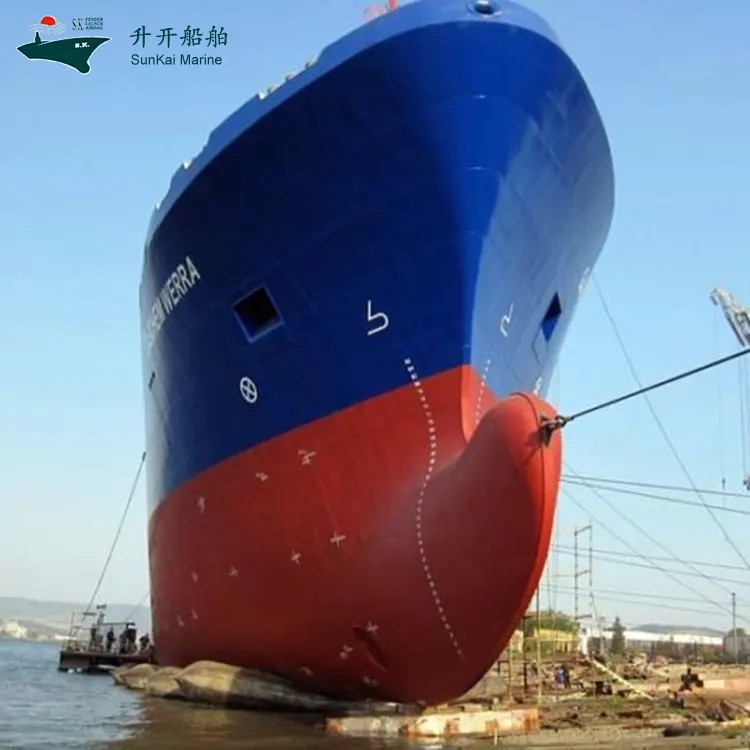
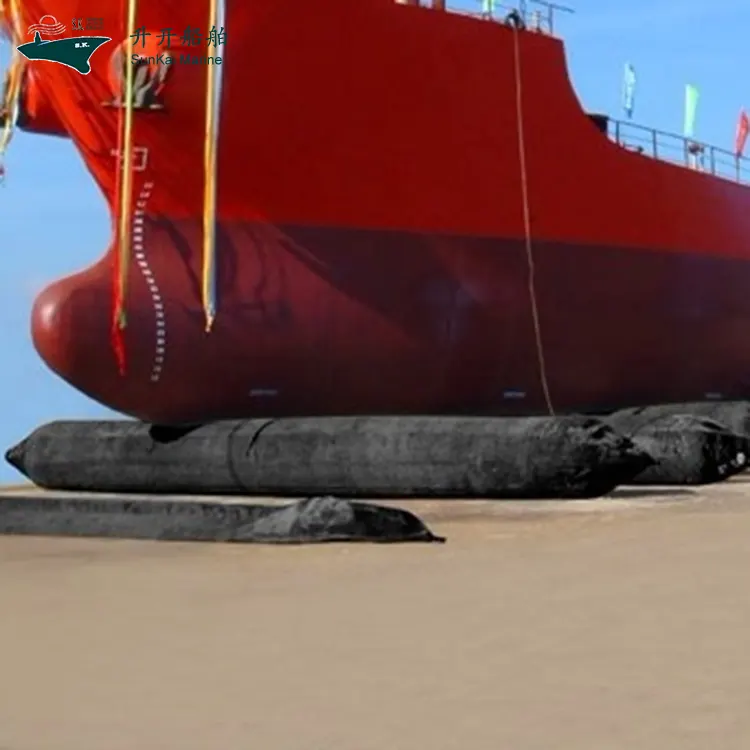
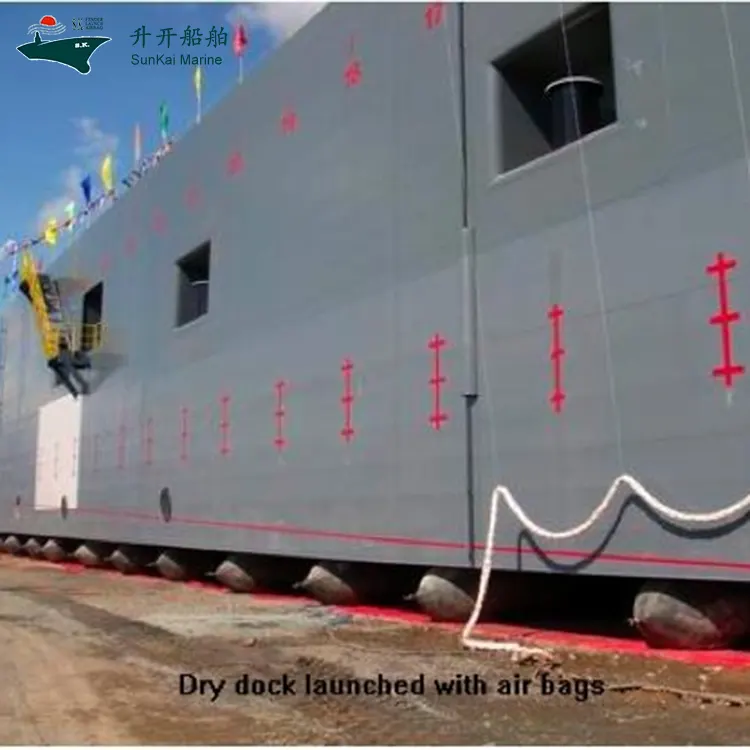
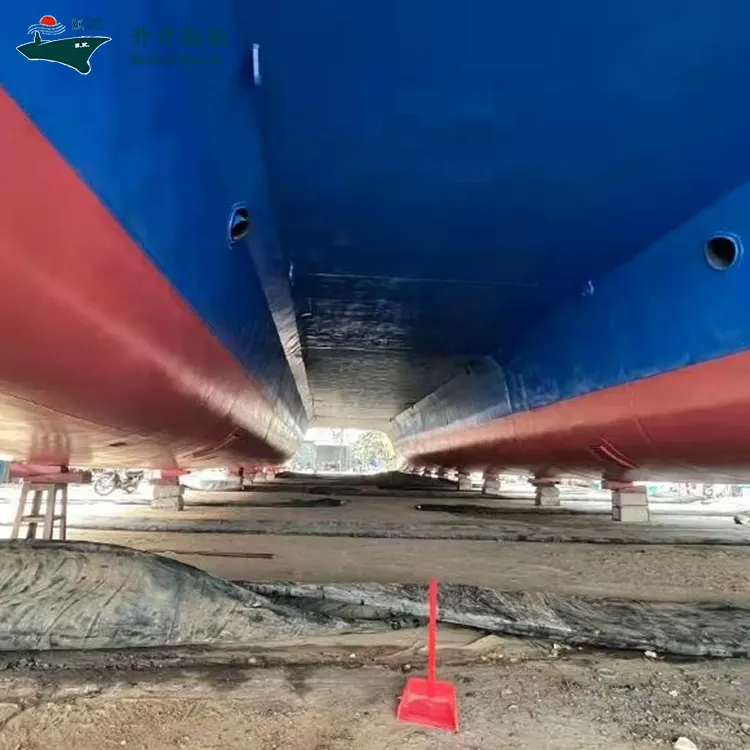
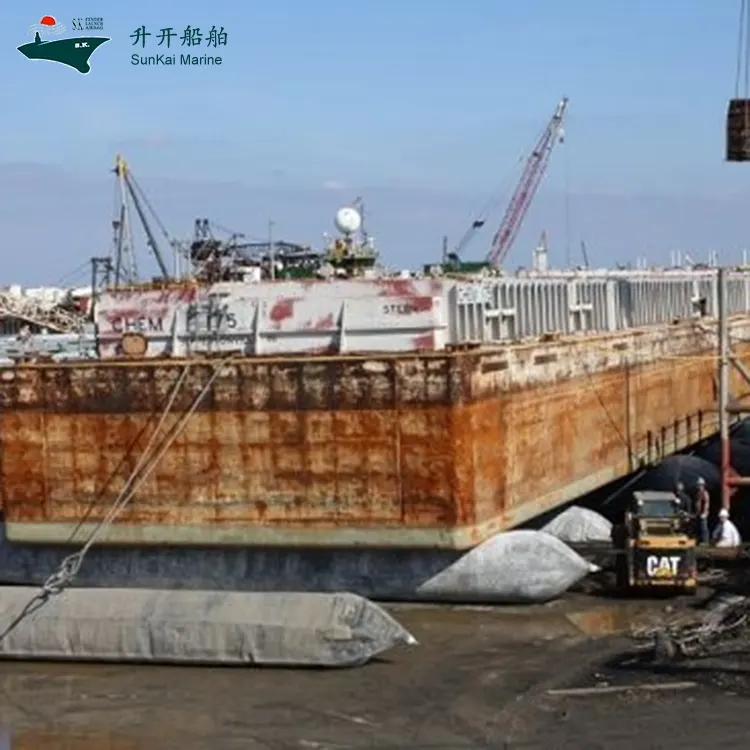
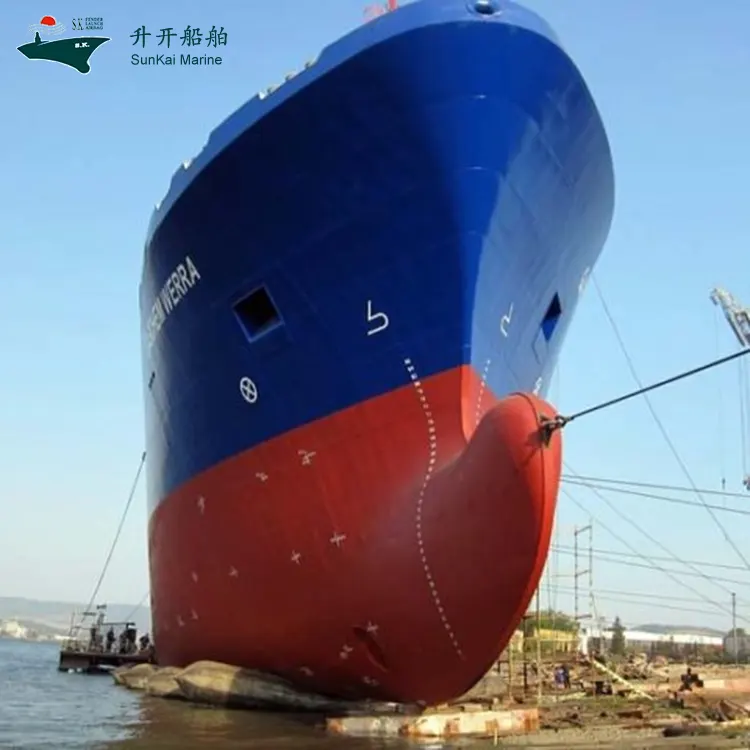
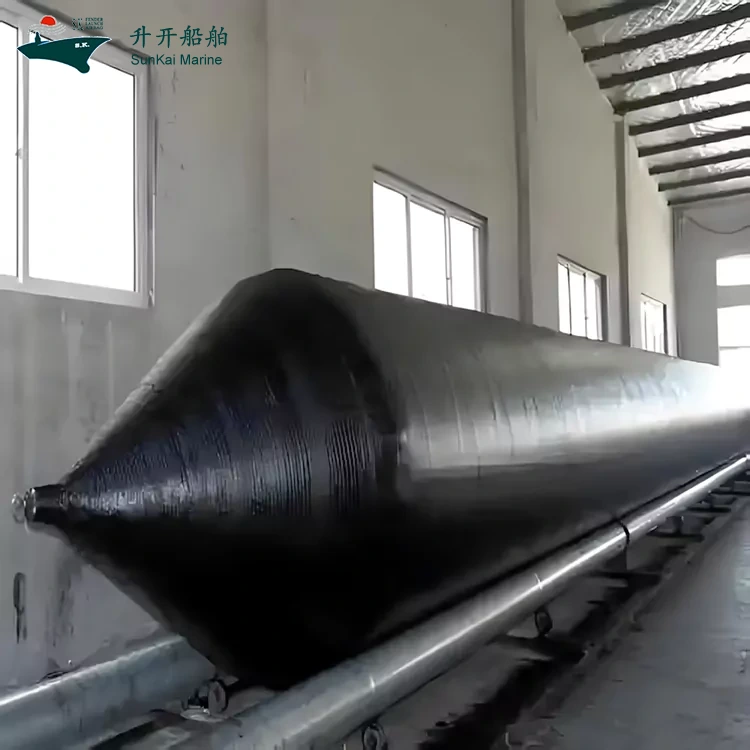
Qingdao SunKai Marine Supplies Co., Ltd. manufactures Vessel Launching Rubber Airbags using integral winding molding process with uniform cord stress, delivering over 15% higher load capacity than traditional lap-joint molding. Proven for safe launching of vessels up to 75,000 DWT, suitable for seaside slipways, inland river dry docks and various new vessel launching, significantly reducing shipyard infrastructure investment. Manufactured per ISO 14409 and ISO 17682 standards, safety factor no less than 3.0. Welcome major shipyards to place bulk orders, with on-site technical guidance and training provided.
Qingdao SunKai Marine Supplies Co., Ltd. manufactures Vessel Launching Rubber Airbag, our flagship heavy-duty launching airbag featuring integral winding molding for uniform cord stress distribution, delivering 15% higher load capacity than traditional lap-joint designs. Built to ISO 14409:2011 and CB/T 3795 standards with multi-layer synthetic tire cord reinforcement and natural rubber compounds, these airbags are suitable for launching various vessel types from small boats to large tonnage vessels. Welcome new shipbuilding yards to contact us for purchase inquiries.
Working Principle, Materials & Process
Material Composition:
This product adopts a three-layer composite structure design:
(1) Outer Rubber: Natural rubber blended with synthetic rubber, compounded with anti-aging agents, UV absorbers and wear-resistant fillers, providing excellent wear, aging and seawater corrosion resistance, typically 2-3mm thick.
(2) Reinforcement Skeleton Layer: Multi-layer high-strength synthetic tire cord (nylon 66 or polyester cord) compounded with rubber, cord wound at spiral angles, single cord breaking strength >= 205N/strand, serving as the core load-bearing structure.
(3) Inner Rubber: Chlorobutyl rubber or natural rubber compound with excellent airtightness, approximately 1.5-2mm thick, ensuring long-term sealing of compressed air and preventing gas permeation leakage.
Manufacturing Process:
The product uses integral winding molding plus high-temperature vulcanization as core processes:
Integral Winding Molding: Using specialized CNC winding equipment, continuously winding rubber-coated cord fabric onto a cylindrical mandrel at designed angles (typically 45-60 degrees) and layer counts, ensuring uniform cord stress in circumferential and axial directions, eliminating stress concentration issues of traditional lap-joint molding.
High-Temperature Vulcanization: Placing the molded airbag with mandrel into large autoclaves, curing for 2-4 hours under approximately 150C saturated steam pressure, enabling cross-linking reactions of rubber molecules to form a stable three-dimensional network structure, imparting excellent elasticity, strength and durability.
Specifications
Main specifications of this product series. Other sizes can be customized upon request.
Model
Diameter(m)
Init.Press(kPa)
Rated Press(kPa)
Capacity(kN/m)
Min.Burst(kPa)
YB-3
0.8
25
130
114
390
YB-4
1.0
18
100
110
300
YB-5
1.2
15
85
112
260
YB-6
1.5
13
70
115
210
YB-7
1.8
16
90
178
270
YB-8
2.0
14
80
185
240
YB-9
2.5
10
60
200
180
Selection Guide
Proper selection is critical for ensuring safety and economy in vessel launching and haul-out operations. Consider the following factors:
· Vessel Parameters: Calculate required total load capacity based on DWT, overall length, beam, depth and lightship weight.
· Airbag Diameter: Larger diameter provides greater load-bearing area and higher capacity per unit length, but requires more under-keel clearance. Common choice: 1.0m-2.0m.
· Airbag Length: Effective length should exceed vessel beam by 0.8-1.2m on each side for stable hull support. Common length: 6m-18m.
· Cord Layers: More layers provide higher load capacity and safety factor. Generally 4-8 layers for launching, 8-12 layers for heavy vessels or high-pressure conditions.
· Working Pressure: Calculate required pressure based on vessel weight and airbag quantity, ensuring it does not exceed rated working pressure with adequate safety margin.
· Quantity Configuration: Determine quantity based on vessel weight and single-airbag capacity, typically one every 3-5m along hull length, plus 1-2 standby units.
· Slipway Conditions: Consider slipway gradient, ground flatness and ground material, which affect airbag stress and rolling performance.
Product Comparison
The table below compares airbag launching with other traditional launching methods:
Comparison Item
Airbag Launching
Gravity Slipway
Floating Dry Dock
Infrastructure Investment
Low - only flat slipway and winch needed
High - dedicated slipway and blocks required
Very high - large floating dock construction
Applicable Vessel Tonnage
Flexible - from small boats to 75,000 DWT
Limited by slipway load capacity
Limited by dock dimensions
Operational Flexibility
High - position and quantity adjustable anytime
Low - fixed slipway location
Medium - subject to dock scheduling
Safety
High - elastic buffering, strong controllability
Medium - descent speed control difficult
High - but in-dock operational risks exist
Why Choose Qingdao SunKai Marine
Professional Manufacturing Experience: Qingdao SunKai Marine Supplies Co., Ltd. has focused on marine airbag R&D and manufacturing for over a decade, with products exported to more than 50 countries and regions, cumulative delivery exceeding 10,000 airbags, and extensive engineering practice experience.
Strict Quality Control: ISO 9001 quality management system certified; products manufactured in strict compliance with ISO 14409:2011 and CB/T 3795 standards; every unit undergoes full delivery inspection.
Independent R&D Capability: Professional R&D team and laboratory, capable of customized design for special customer requirements, including ultra-large diameter, ultra-high pressure and puncture-resistant special models.
Comprehensive After-Sales Service: 24-month product warranty; free repair or replacement for manufacturing quality issues during warranty period; lifetime technical support and on-site operational guidance services.
Fast Delivery Capability: Multiple automated production lines and large vulcanization equipment; standard models delivered in 7-15 days, urgent orders can be expedited to meet customer schedule requirements.
Global Certification Qualifications: Products available with CCS, BV, ABS, LR, DNV and other major classification society certifications, meeting vessel classification requirements of different countries and regions.
Frequently Asked Questions (FAQ)
Q1: What is the maximum vessel size for airbag launching?
A1: The largest vessel successfully launched using marine airbags is 75,000 DWT. Theoretically, by increasing airbag quantity and capacity, even larger vessels can be launched with detailed engineering calculations.
Q2: What are advantages over traditional slipway?
A2: Key advantages: minimal infrastructure investment, operational flexibility, safety and controllability with elastic buffering, wide applicability from small boats to tens of thousands of tons, and economic efficiency.
Q3: What are the slipway requirements?
A3: Slipway should have sufficient load capacity and flatness, with gradient typically 1:20 to 1:10 (3-6 degrees). Ground material can be concrete, compacted soil, or sand/gravel. No sharp protrusions.
Q4: Why choose Qingdao SunKai Marine airbags?
A4: Integral winding molding technology for uniform cord stress delivers 15%+ higher load capacity. Certified to ISO 9001 and ISO 14409 with full inspection on every unit. 24-month warranty and lifetime technical s
Send your inquiry to SunKai now! Get a quick quote for our quality Marine Airbag, Marine Fender, Marine Buoys. Our China team offers professional support.
We use cookies to offer you a better browsing experience, analyze site traffic and personalize content. By using this site, you agree to our use of cookies. Privacy Policy