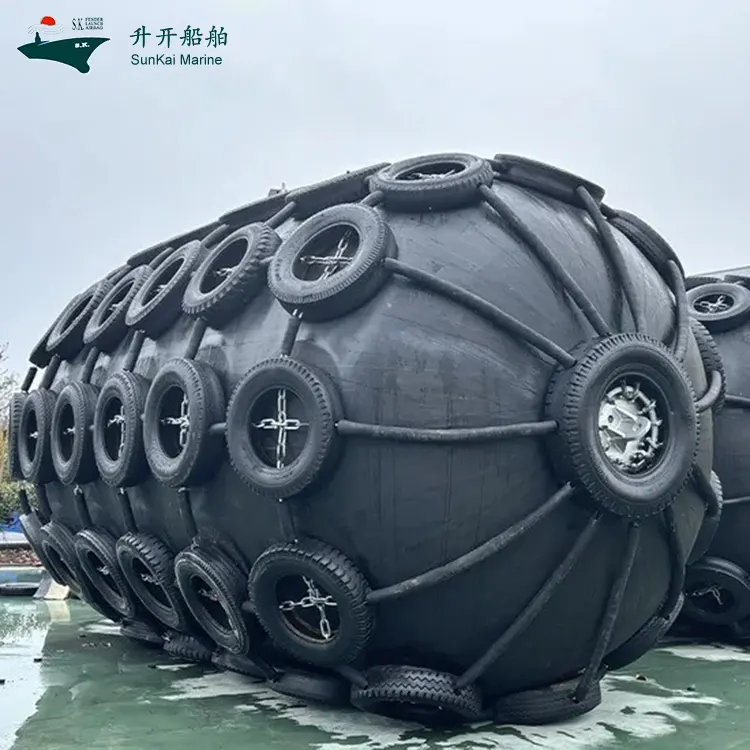
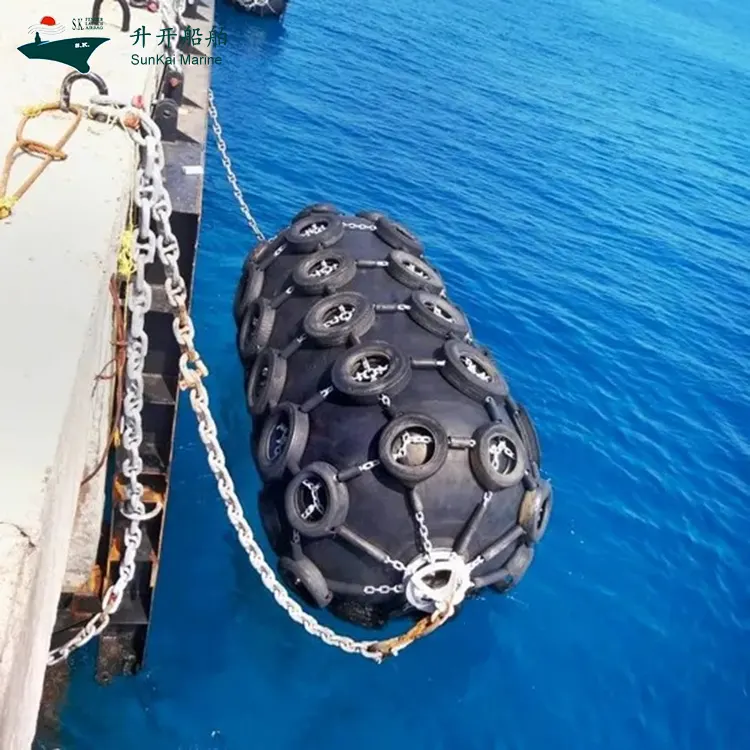
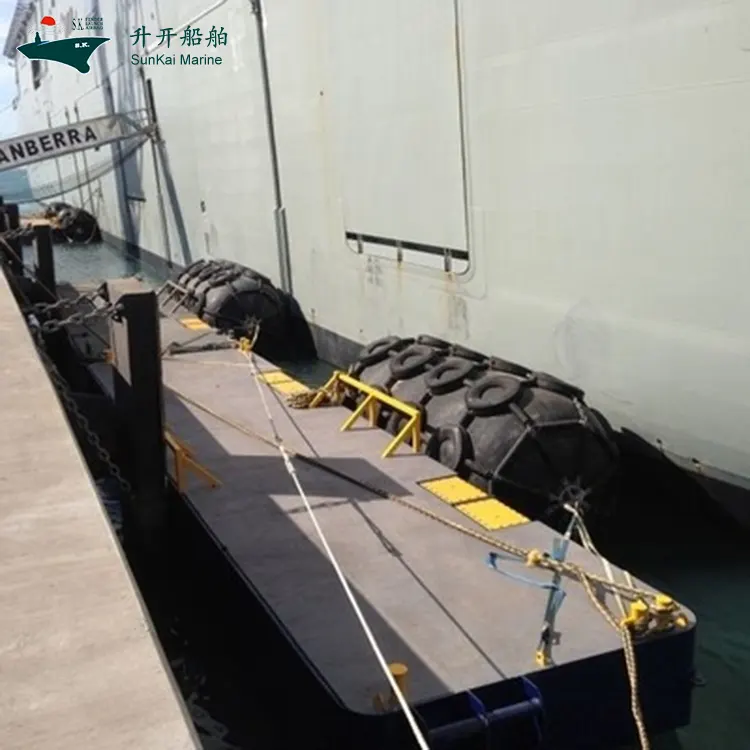
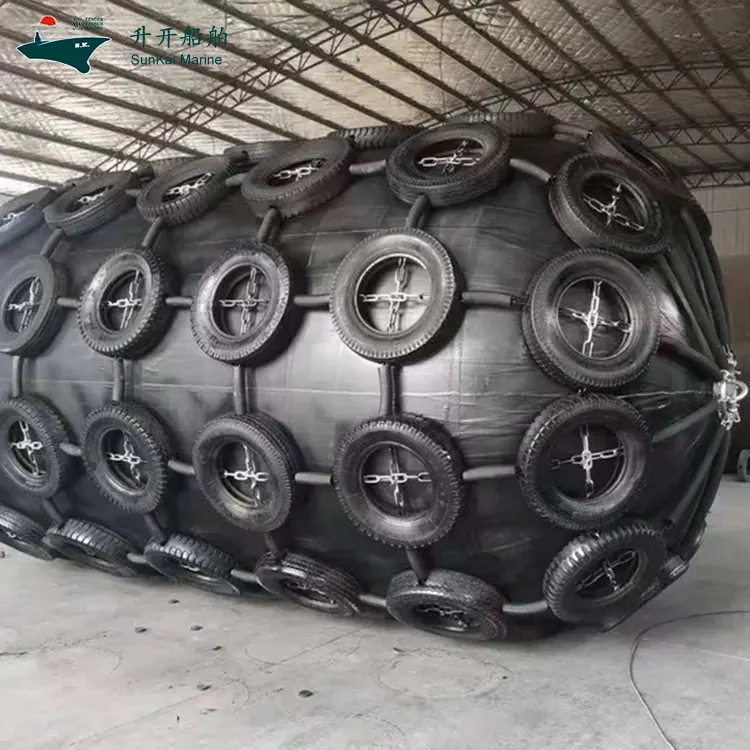
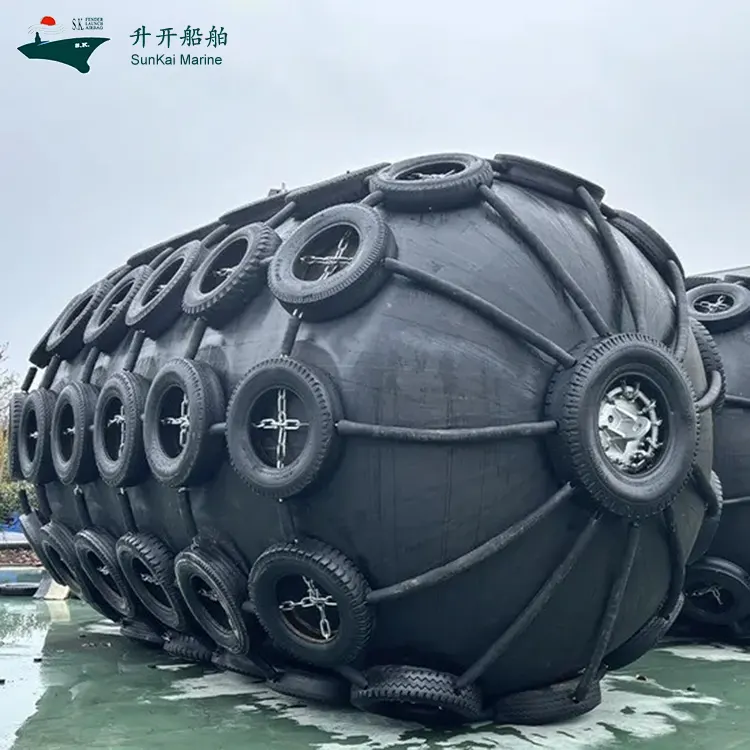
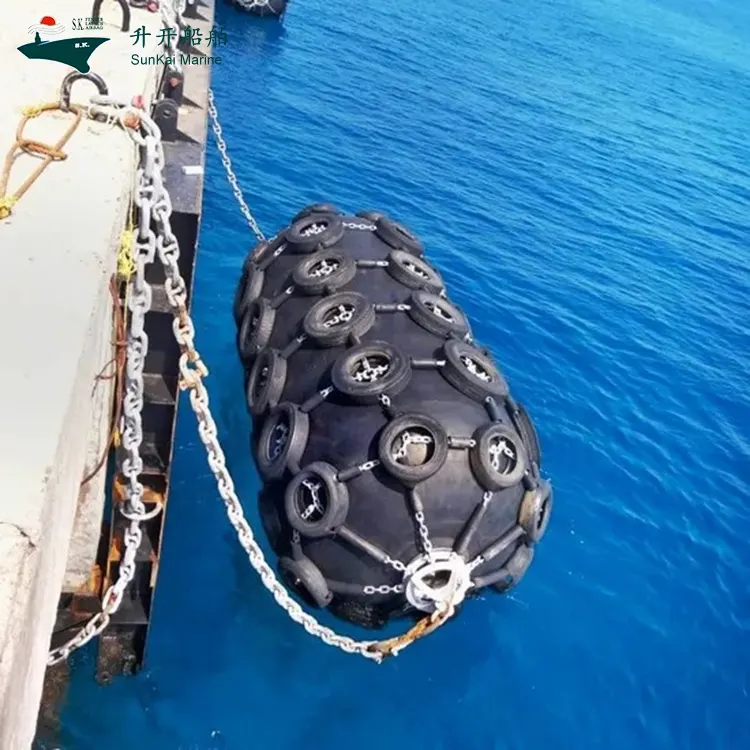
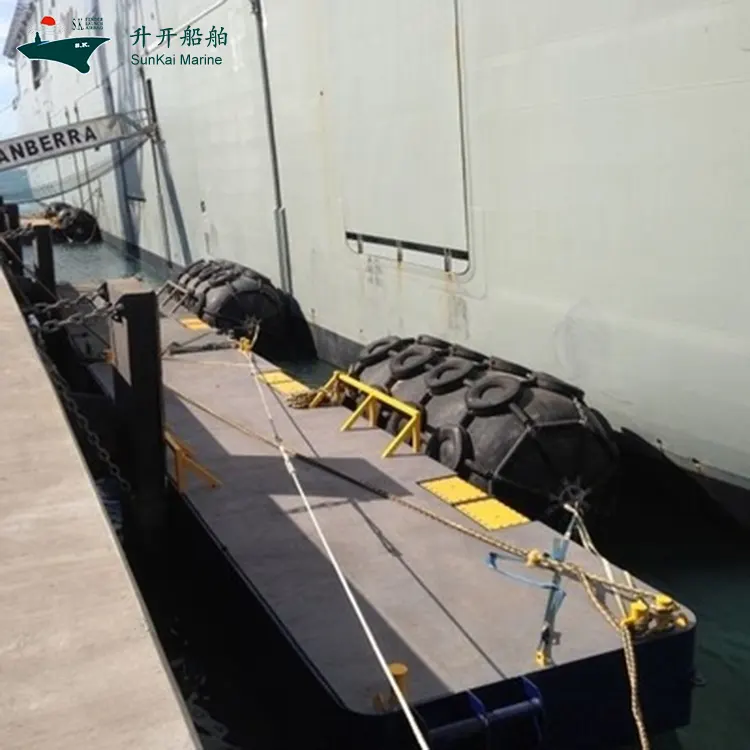
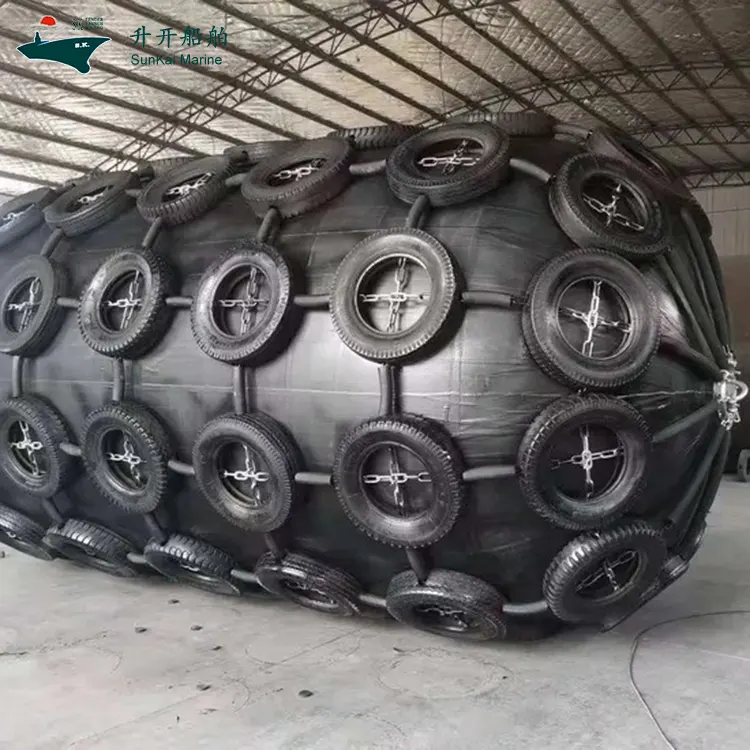
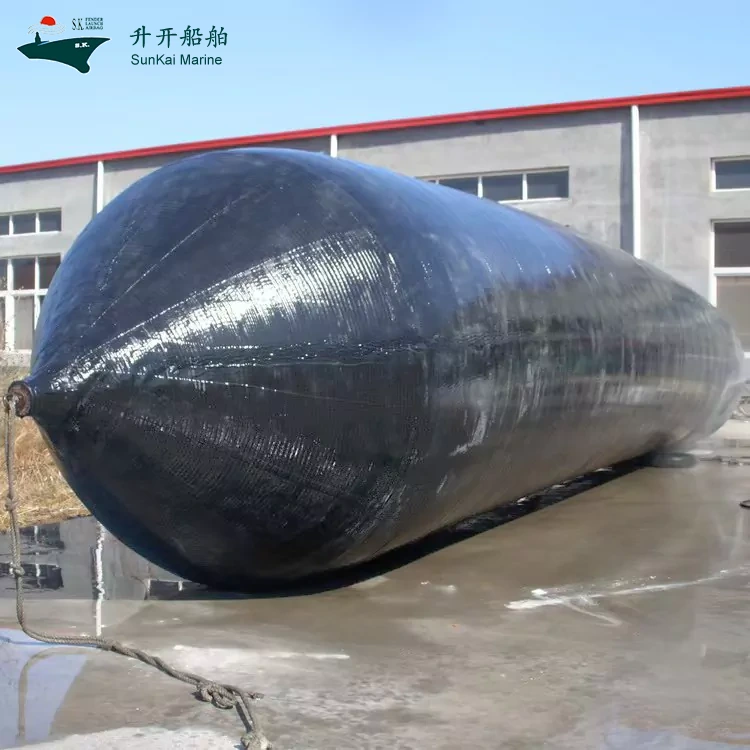
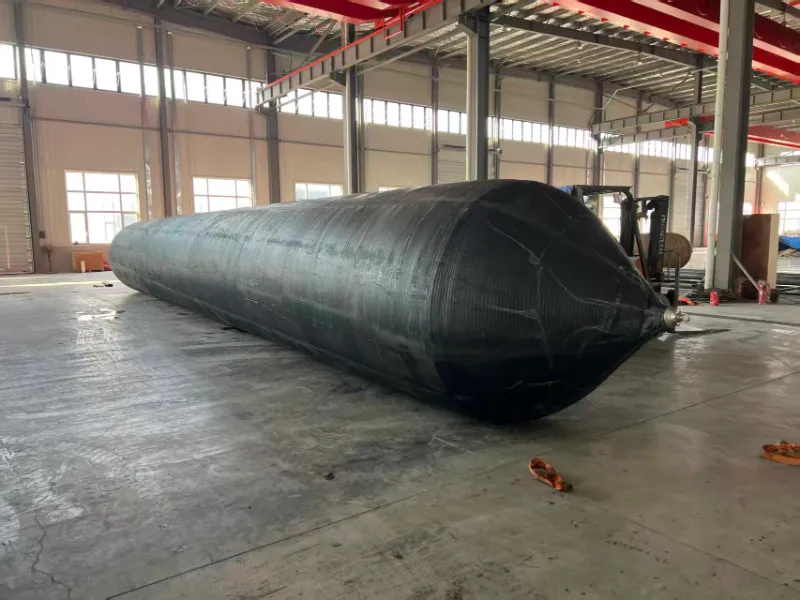
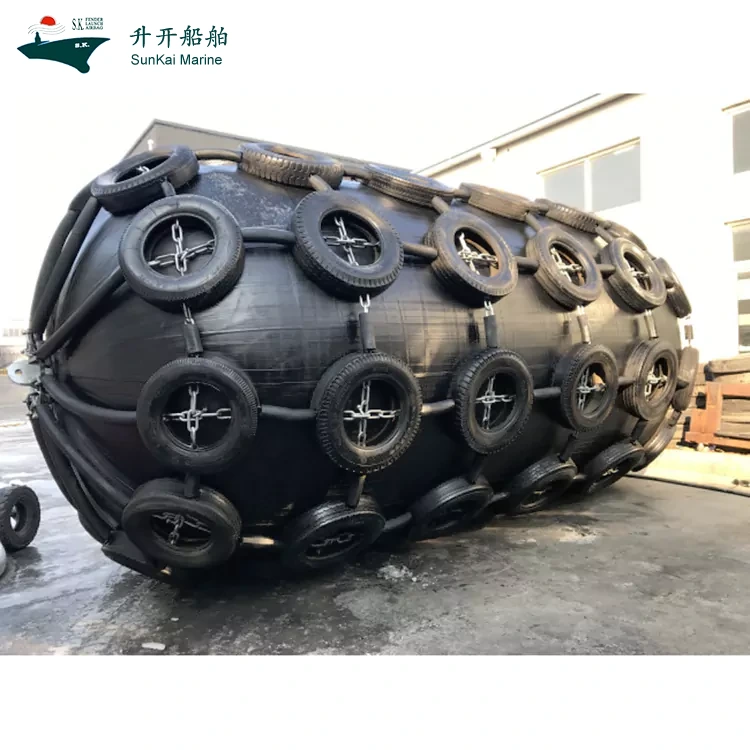
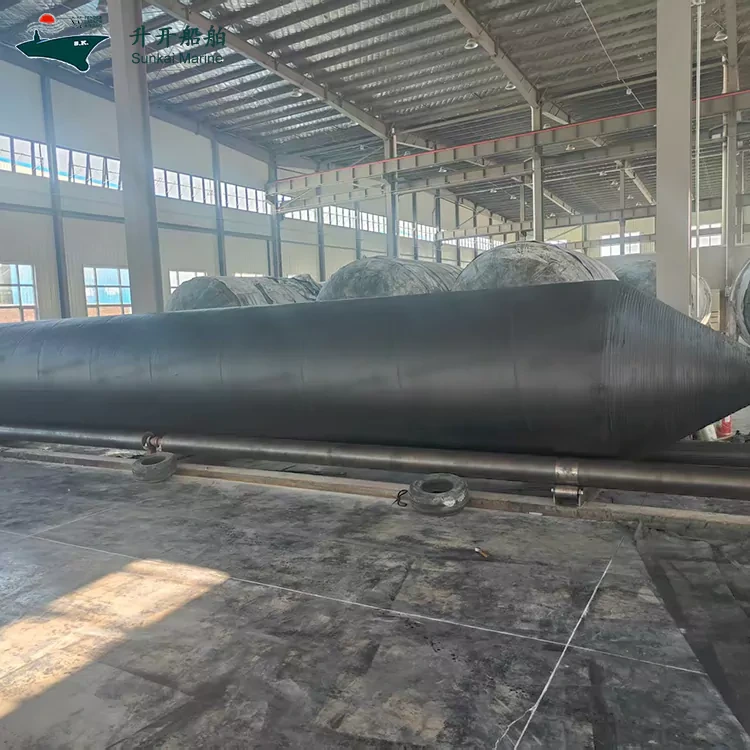
SunKai Chain Tire Net Floating Rubber Fender delivers reliable pneumatic marine fender solutions for ports, offshore platforms and ship berthing scenarios. Featuring a floating air‑filled structure, it automatically adjusts working height following tidal fluctuations and vessel draft changes. The outer chain‑tire net reinforces abrasion resistance and impact resistance, making it well‑suited for large‑tidal‑range locations and marine berthing operations requiring dependable protection.
SunKai Chain Tire Net Floating Rubber Fender offers custom floating fender solutions for marine and port protection systems. Its pneumatic structure relies on compressed air to sustain buoyancy and keep the fender afloat on the water surface, while the external chain‑tire net upgrades wear resistance and impact buffering performance.
Fabricated from marine‑grade rubber and reinforced cord layers, this fender adopts integrated wrapping and high‑temperature vulcanization technology to secure excellent air tightness and structural durability. Available in multiple sizes and pressure grades, it is widely applied for vessel berthing, offshore terminals, ship‑to‑ship transfer and large‑tidal‑range ports.
Key Features
• Floating pneumatic structure, auto‑adapt to tide‑level variations
• Ideal for ports with large tidal differences
• Compatible with vessels of different drafts
• Chain‑tire net delivers extra wear‑proof and anti‑impact protection
• Air‑filled chamber ensures stable buoyancy
• High energy absorption with controlled reaction force
• Reliable compression performance under diverse berthing angles
• Light‑weight design for easy transportation and installation
• Deflatable construction for convenient storage and maintenance
Performance Features
Integrated Rubber Reinforcement Structure
SunKai Chain Tire Net Floating Rubber Fender are made of marine‑grade wear‑resistant rubber together with multi‑ply high‑strength cord fabric.
The fender body is formed by integrated wrapping and high‑temperature vulcanization without split joints. This improves air‑tightness and lowers risks of air leakage or cracking over long‑term service.
Chain Tire Net Protection System
The chain‑tire net fully wraps the pneumatic fender body. Upon vessel contact, rubber tires provide primary elastic cushioning before impact loads are transferred to the air chamber.
This design boosts abrasion resistance and guards the fender body against direct damage from steel surfaces, concrete edges and harsh marine operating environments.
Stable Energy Absorption Performance
The pneumatic structure achieves progressive compression under berthing impact. It absorbs vessel kinetic energy while confining reaction force within a reasonable range, protecting both vessels and dock infrastructures.
Standard dimensions available | Custom dimensions are acceptable
The table below lists performance data of SunKai Chain Tire Net Floating Rubber Fender at 60% compression deflection under different initial internal pressure.
Fender Diameter D (mm)
Fender Length L (mm)
Reaction Force at 50 kPa (kN)
Energy Absorption at 50 kPa (kJ)
Reaction Force at 80 kPa (kN)
Energy Absorption at 80 kPa (kJ)
500
1000
64
6
85
8
600
1200
86
10
108
13
700
1500
137
17
180
24
1000
1500
182
32
239
45
1000
2000
257
45
338
63
1200
2000
297
63
390
88
1350
2500
427
102
561
142
1500
3000
579
153
761
214
1700
3000
639
191
840
287
2000
3500
875
308
1150
430
2500
4000
1381
663
1815
925
2500
5500
2019
943
2653
1317
3000
5000
2000
1050
2709
1571
3000
6000
2488
1312
3292
1888
3300
4500
1884
1175
2476
1640
3300
6000
2783
1675
3652
2338
3300
6500
3015
1814
3961
2532
3300
10600
5257
3067
6907
4281
4500
9000
5747
4752
7551
6633
Note: The above covers common‑use sizes. SunKai can customize floating rubber fenders in terms of dimension, internal pressure, energy‑absorption capacity and installation solutions to match client requirements.
Applications
SunKai Chain Tire Net Floating Rubber Fender is applicable for:
‑ Commercial ports and terminals
‑ Offshore platforms
‑ Ship‑to‑ship transfer operations
‑ Shipyards and repair docks
‑ Large‑tidal‑range berths
‑ Inland waterways and coastal terminals
‑ Marine construction projects
Manufacturing Capability
SunKai delivers professional floating rubber fender manufacturing services:
‑ Rich experience in pneumatic marine fender production
‑ Strict inspection for rubber raw material, cord layer, vulcanization quality and air‑tightness performance
‑ Quality control on buoyancy performance and chain‑tire net assembly
‑ Ready standard specifications for fast delivery
‑ Support custom dimensions and configurations
‑ Provide technical guidance for installation & operation
Installation and Maintenance
Before installation, inspect the following items:
‑ Surface condition of rubber body
‑ Connection points of chain‑tire net
‑ Shackles and flange components
‑ Internal air pressure
During operation:
‑ Avoid contact with sharp‑edged objects
‑ Do not exceed rated working pressure
‑ Carry out regular air‑pressure checks
‑ Periodically inspect chain‑tire net status
For storage:
‑ Rinse salt deposits with fresh water
‑ Fully dry before storage
‑ Release partial air pressure prior to folding
‑ Store in dry and ventilated space
‑ Keep away from direct sunlight and abrasive ground surfaces
Frequently Asked Questions
Does a floating rubber fender require manual adjustment in large tidal range ports?
No. The compressed‑air chamber supplies buoyancy, so the fender stays afloat and automatically adjusts working height responding to tide changes and vessel draft shifts.
What pressure options are available for SunKai floating rubber fenders?
SunKai Chain Tire Net Floating Rubber Fender commonly adopts 50 kPa and 80 kPa initial internal pressure options. Different pressure grades deliver varied reaction‑force and energy‑absorption performance.
Can SunKai customize the floating rubber fender size?
Yes. Diameter, length, pressure rating, energy‑absorption capacity, chain‑tire net setup and connecting accessories can be customized according to vessel demands and installation conditions.
How is the floating fender installed on a dock?
The fender is generally connected via end flanges, shackles, mooring ropes or chains. Such connection system allows vertical movement following tide changes while maintaining stable protective performance.
What maintenance is required for the chain tire net floating rubber fender?
Routine checks on air pressure, rubber condition and chain‑tire net connections are recommended. Removing seawater residues and marine organisms helps sustain long‑term service performance.
Send your inquiry to SunKai now! Get a quick quote for our quality Marine Airbag, Marine Fender, Marine Buoys. Our China team offers professional support.
We use cookies to offer you a better browsing experience, analyze site traffic and personalize content. By using this site, you agree to our use of cookies. Privacy Policy