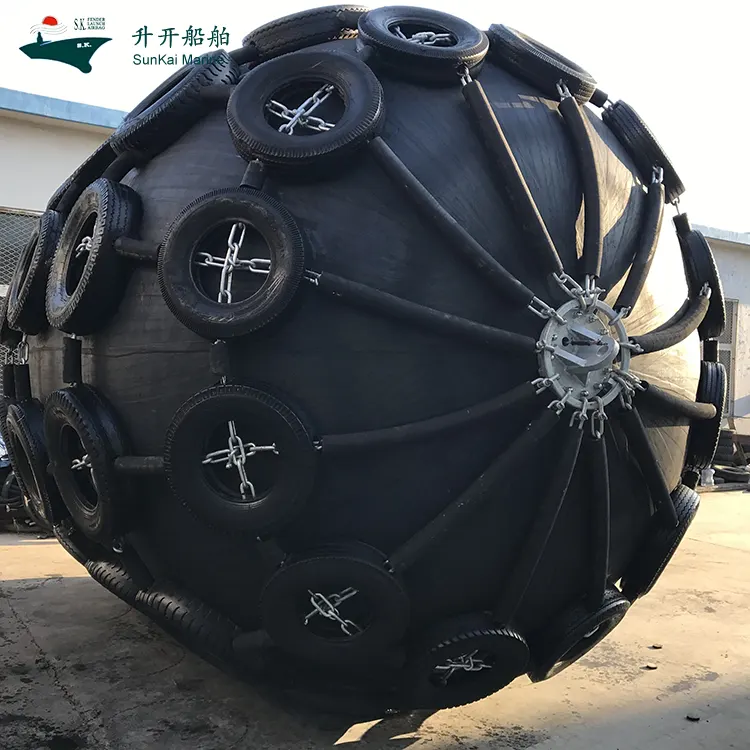
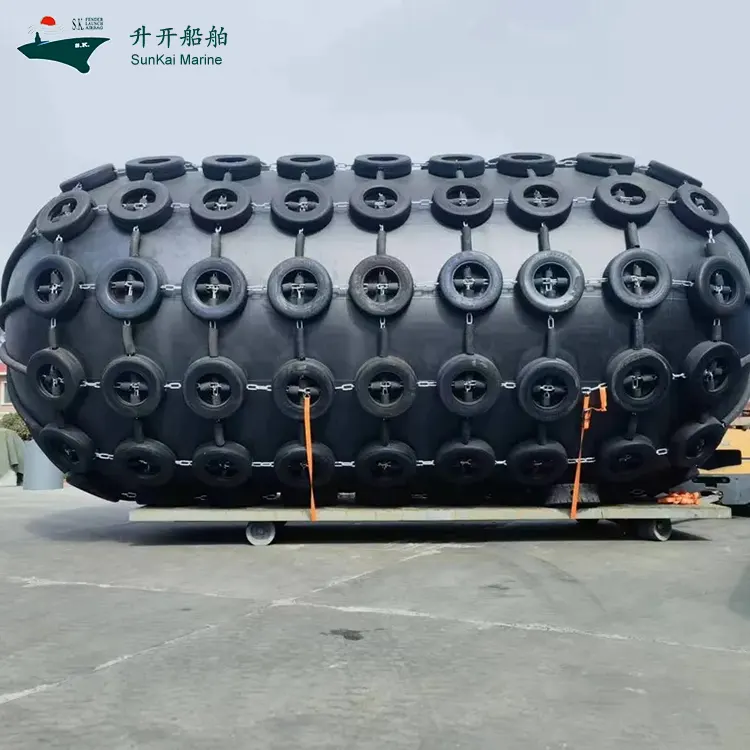
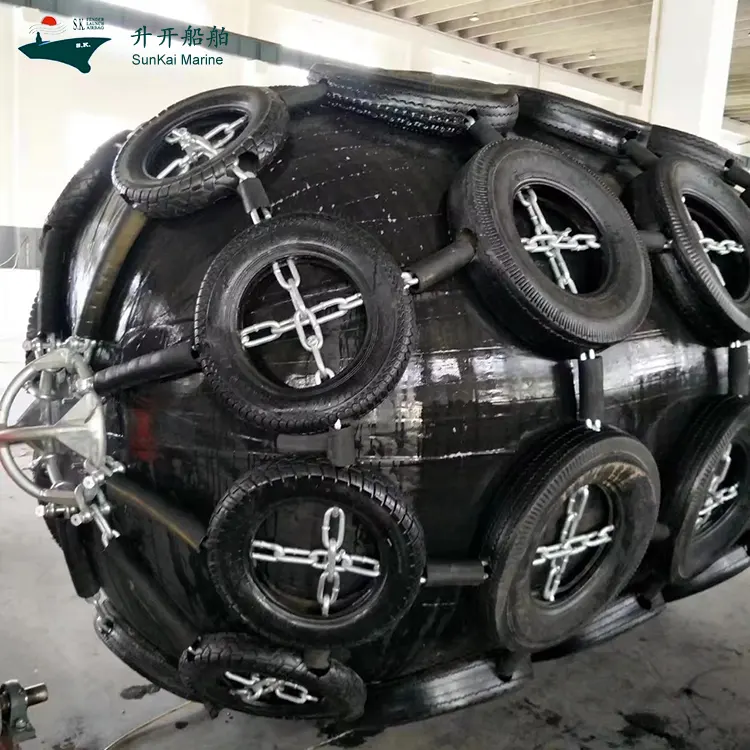
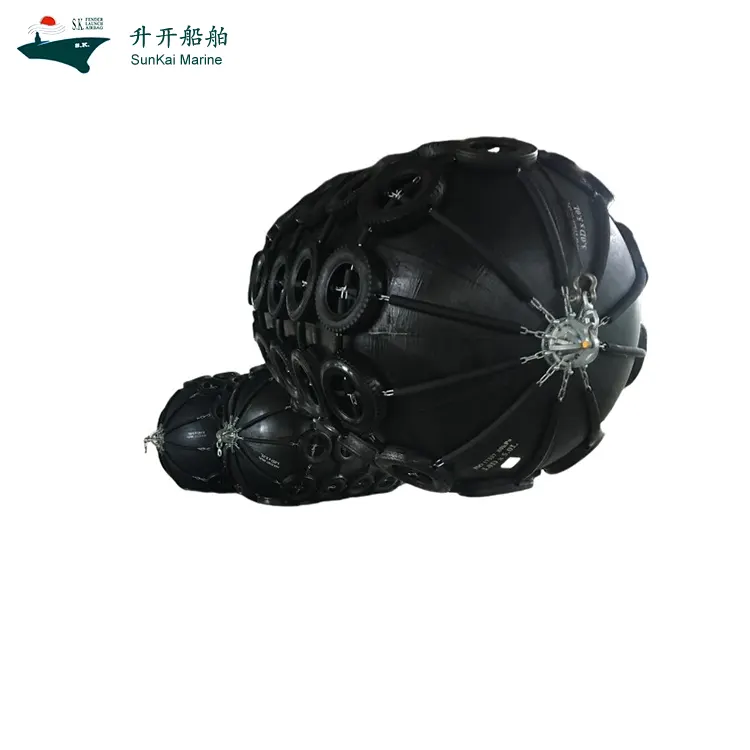
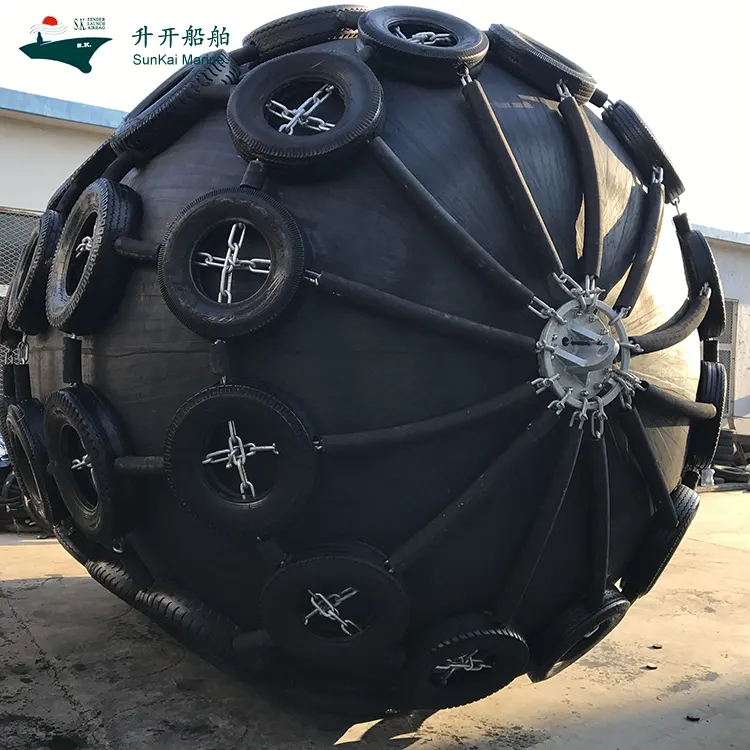
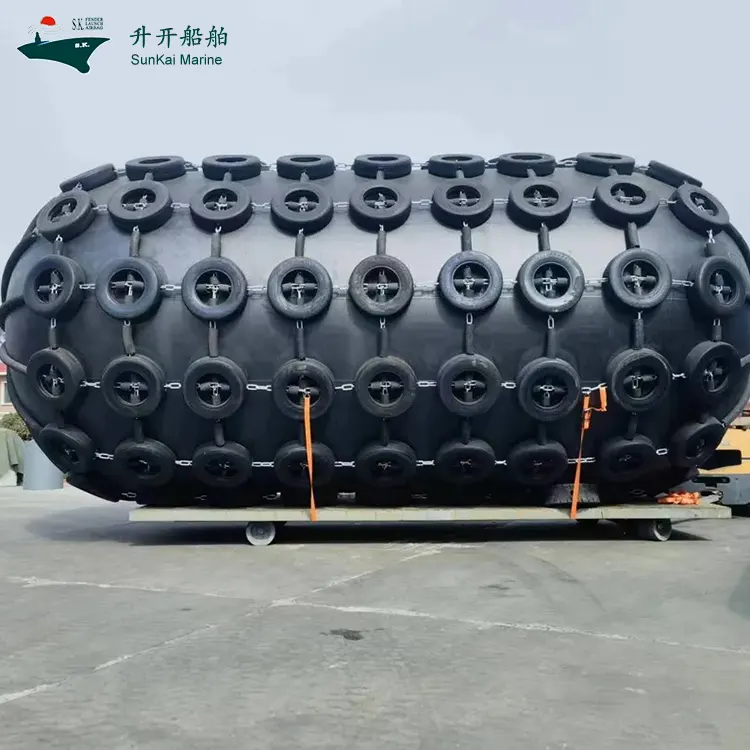
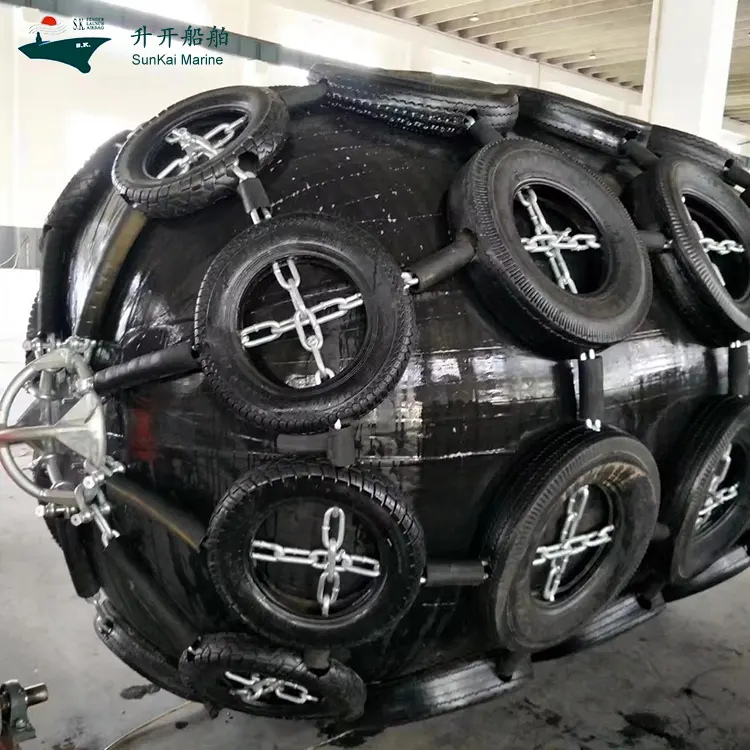
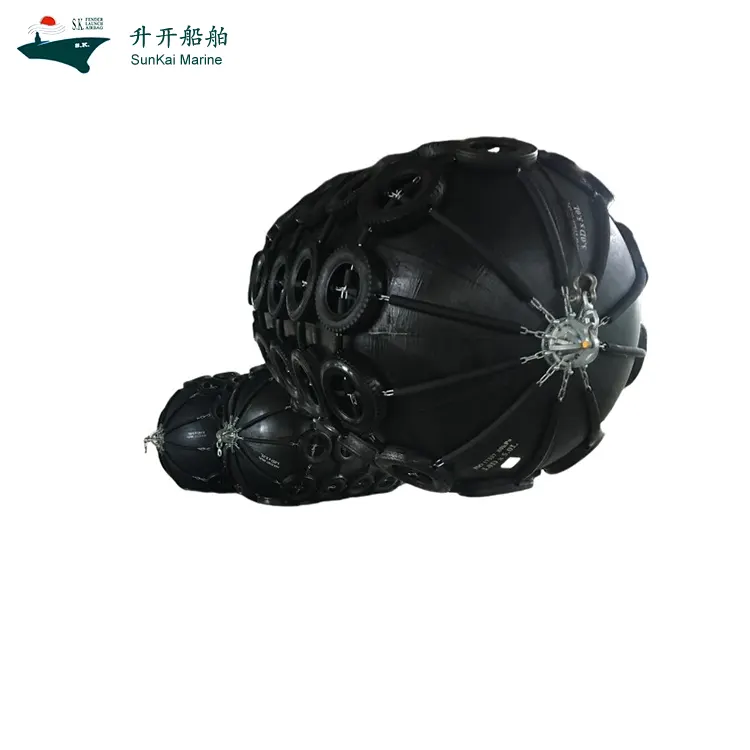
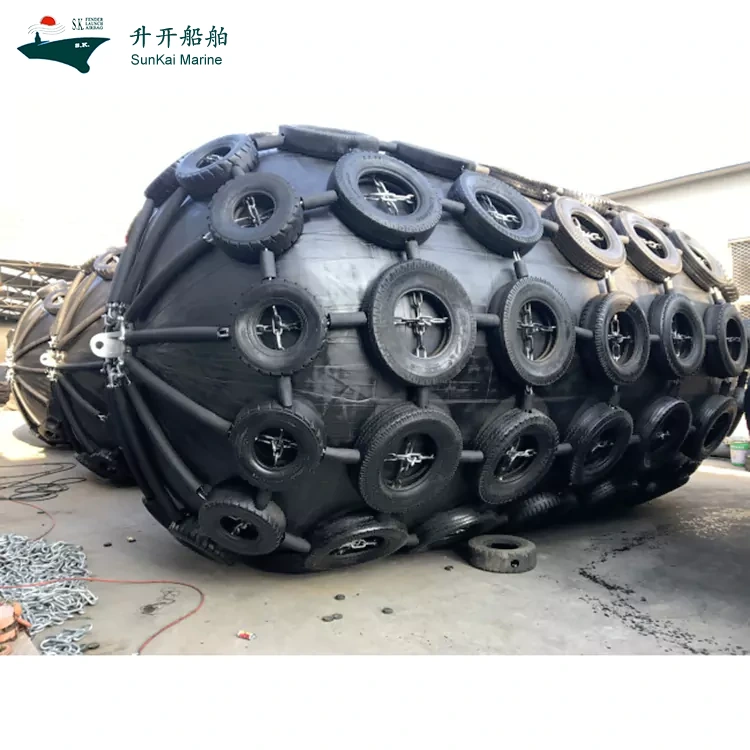
SunKai Chain Net Covered Pneumatic Rubber Fender delivers heavy‑duty berthing protection for ports, terminals and ship transfer operations that demand superior abrasion resistance. The full‑coverage chain net shields the pneumatic rubber body from direct impact and surface damage. Meanwhile, the compressed‑air chamber achieves high energy‑absorption performance with low reaction force. It fits harsh marine scenarios requiring long service life and stable cushioning performance.
SunKai Chain Net Covered Pneumatic Rubber Fender offers custom pneumatic fender solutions for heavy‑duty marine applications. Different from standard pneumatic fenders with limited outer protection, this model adopts a full surrounding chain‑net cover, which spreads contact pressure over a larger area during vessel berthing.
This fender consists of an inner air‑tight rubber layer, multi‑ply reinforced cord layers and an outer wear‑resistant rubber layer. Produced by integrated wrapping and high‑temperature vulcanization, the pneumatic body has no spliced joints, which enhances structural strength and air‑tightness.
Compressed air inside serves as the cushioning medium. When berthing impact occurs, the air chamber absorbs vessel kinetic energy through controlled compression, generating moderate reaction force and lowering surface pressure on both hull and quay structures.
Hot‑dip galvanized chain net provides extra mechanical defense against abrasion, sharp edges and frequent contact. Available in 50 kPa and 80 kPa pressure grades, SunKai can tailor this fender for different vessel sizes, berth conditions and energy‑absorption demands.
Full Chain Net Covering Design
The core feature of SunKai Chain Net Covered Pneumatic Rubber Fender is the full‑wrap outer chain‑net structure.
The chain net fully encloses the pneumatic rubber body and acts as a protective buffer between fender surface and external contact objects. During berthing, impact loads are dispersed via the chain framework instead of concentrating on partial rubber surfaces.
This design brings the following benefits:
‑ Reduce partial rubber wear
‑ Resist damage from sharp quay edges and steel structures
‑ Improve tolerance to repeated berthing impacts
‑ Extend service life of the pneumatic main body
The chain net is processed with hot‑dip galvanizing to gain good resistance against seawater corrosion and salt‑spray erosion.
Compressed Air Energy Absorption System
The inner compressed‑air chamber undertakes the major cushioning function.
When vessels strike the fender, internal air compresses gradually, absorbing impact energy while keeping reaction force under control. Compared with solid rubber fenders, pneumatic types feature lower surface pressure and more flexible contact behavior.
Advantages brought by pneumatic construction:
‑ High energy‑absorption capacity
‑ Low reaction force
‑ Reduced hull surface pressure
‑ Stable compression performance under varied berthing angles
The fender can maintain valid protection even when vessels approach from different contact angles.
The main body is formed by integrated wrapping and high‑temperature vulcanization. Seamless construction cuts down failure risks brought by joints and improves long‑term air‑tight reliability.
Every fender goes through complete inspection items:
‑ Rubber layer quality
‑ Cord reinforcement density
‑ Vulcanization status
‑ Air‑tight performance
‑ Chain net assembling quality
Performance Characteristics
Low Reaction Force and High Energy Absorption
The compressed‑air cushioning system enables the fender to consume large impact energy and constrain reaction force. It mitigates stress transferred to vessel hulls and quay walls in berthing events.
Reduced Hull Surface Pressure
Pneumatic contact interface realizes soft interaction between vessel and berth. Lower surface pressure helps protect:
‑ Ship paint systems
‑ Hull structures
‑ Quay surfaces
Improved Wear Resistance
Full‑enclosed chain net avoids direct friction between rubber body and external objects. It is especially suitable for scenarios with frequent vessel contacts or harsh operating surroundings.
Reliable Marine Durability
Marine‑grade rubber, reinforced cord layers plus galvanized chain protection jointly build resistance to:
‑ Seawater corrosion
‑ Salt spray
‑ Mechanical abrasion
‑ Cyclic impact loads
Product Specifications
Fender Diameter D (mm)
Fender Length L (mm)
Reaction Force at 50 kPa (kN)
Energy Absorption at 50 kPa (kJ)
Reaction Force at 80 kPa (kN)
Energy Absorption at 80 kPa (kJ)
500
1000
64
6
85
8
600
1200
86
10
108
13
700
1500
137
17
180
24
1000
1500
182
32
239
45
1000
2000
257
45
338
63
1200
2000
297
63
390
88
1350
2500
427
102
561
142
1500
3000
579
153
761
214
1700
3000
639
191
840
287
2000
3500
875
308
1150
430
2500
4000
1381
663
1815
925
2500
5500
2019
943
2653
1317
3000
5000
2000
1050
2709
1571
3000
6000
2488
1312
3292
1888
3300
4500
1884
1175
2476
1640
3300
6000
2783
1675
3652
2338
3300
6500
3015
1814
3961
2532
3300
10600
5257
3067
6907
4281
4500
9000
5747
4752
7551
6633
Manufacturing Capability
SunKai focuses on pneumatic marine fender production, with solid know‑how in rubber forming, reinforcement processing and chain‑net assembly.
Manufacturing strengths:
‑ Professional production of pneumatic rubber fenders
‑ Mature assembling technology for full‑coverage chain net
‑ Multi‑stage quality inspection workflow
‑ 50 kPa & 80 kPa pressure grade options
‑ Custom dimensions and connecting accessories
‑ Project‑oriented installation guidance
SunKai accepts OEM and custom production according to vessel specifications, berth conditions and protection requirements.
Typical Applications
SunKai Chain Net Covered Pneumatic Rubber Fender is widely applied to:
‑ Large‑vessel berthing terminals
‑ Ship‑to‑ship transfer operations
‑ Oil & gas terminals
‑ Offshore platforms
‑ Heavy‑duty marine docks
‑ Ports with high‑frequency berthing
‑ Steel wharf protection
Installation and Maintenance
Before operation, inspect:
‑ Surface condition of rubber body
‑ Chain net deformation or loose connections
‑ Internal air pressure value
‑ Valve working status
During service:
‑ Keep away from sharp hard objects
‑ Maintain rated internal pressure
‑ Check air pressure on a regular basis
‑ Periodically examine chain links and connection points
Maintenance suggestions:
‑ Rinse salt residues with fresh water after marine service
‑ Store in dry and ventilated environment
‑ Keep away from oil, solvents and strong chemicals
‑ Apply dedicated repair compound for minor rubber damages
Frequently Asked Questions
What is the difference between a chain net covered pneumatic rubber fender and a conventional pneumatic fender?
Standard pneumatic fenders rely mainly on rubber body for outer protection. By contrast, chain‑net covered type adds a full surrounding chain protective jacket.
The chain net distributes contact stress, mitigates surface abrasion and guards rubber body against sharp edges and repeated impacts.
Does the chain net affect the cushioning performance of the pneumatic fender?
No. Cushioning capacity is determined by compressed‑air chamber and rubber body structure.
The chain net serves purely as external protection. It delivers abrasion‑proof and load‑distribution functions without weakening the energy‑absorption capacity of the pneumatic system.
How should customers select 50 kPa or 80 kPa pressure grade?
Selection depends on vessel dimension, berthing energy and target reaction force.
50 kPa offers softer cushioning with lower reaction force; 80 kPa delivers higher energy‑absorption capacity for heavy‑tonnage vessels and severe berthing conditions.
Can SunKai customize chain net covered pneumatic rubber fenders?
Yes. SunKai can customize diameter, length, internal pressure, chain‑net configuration and connection accessories to satisfy customer requirements.
Send your inquiry to SunKai now! Get a quick quote for our quality Marine Airbag, Marine Fender, Marine Buoys. Our China team offers professional support.
We use cookies to offer you a better browsing experience, analyze site traffic and personalize content. By using this site, you agree to our use of cookies. Privacy Policy